
The Wordfence Threat Intelligence team recently reviewed firewall data for websites on Asian country-code top-level domains and identified a sharp increase in attacks targeting .tw (Taiwan) websites, beginning in late October 2026. The number of .tw websites attacked per day approximately tripled, while .jp (Japan), .kr (South Korea), .hk (Hong Kong), .sg (Singapore) and .cn (China) showed no comparable change. We traced the increase to a single IP address, 45.38.60.254. Our records indicate that it started scanning on October 26th, 2026, and the Wordfence Firewall has since blocked or logged over 246,000 requests from it. Of the requests blocked by our Malicious File Upload rule, 82.7% targeted websites on the .tw top-level domain.
According to our logs, these requests were attempts to exploit known vulnerabilities, and they were blocked by the generic rules of the Wordfence Firewall. The data suggests that the attacker was most likely mapping Taiwanese websites, including WordPress sites, in search of vulnerable targets.
Background: attacks on Asian websites
Our firewall data can be broken down by the top-level domain of the protected website, which lets us compare attack activity between regions. For this review we looked at six Asian country-code domains: .tw (Taiwan), .jp (Japan), .kr (South Korea), .hk (Hong Kong), .sg (Singapore) and .cn (China).
For each domain, we counted the websites on which the Wordfence Firewall blocked at least one request per day between September 1st and November 15th, 2026. We did this for five general firewall rules: SQL Injection, Cross-Site Scripting, Malicious File Upload, Malicious File Upload (Patterns) and Malicious File Upload (PHP). All other domains combined served as a global baseline.
Counting websites instead of requests was a deliberate choice. A single attacker attacking a single website can generate a huge number of requests without revealing anything about the region. The number of websites attacked only changes if the attacker acts more widely. According to our data, five of the six domains showed no significant change during this period. The only exception was the .tw domain.
The .tw anomaly
Malicious File Upload
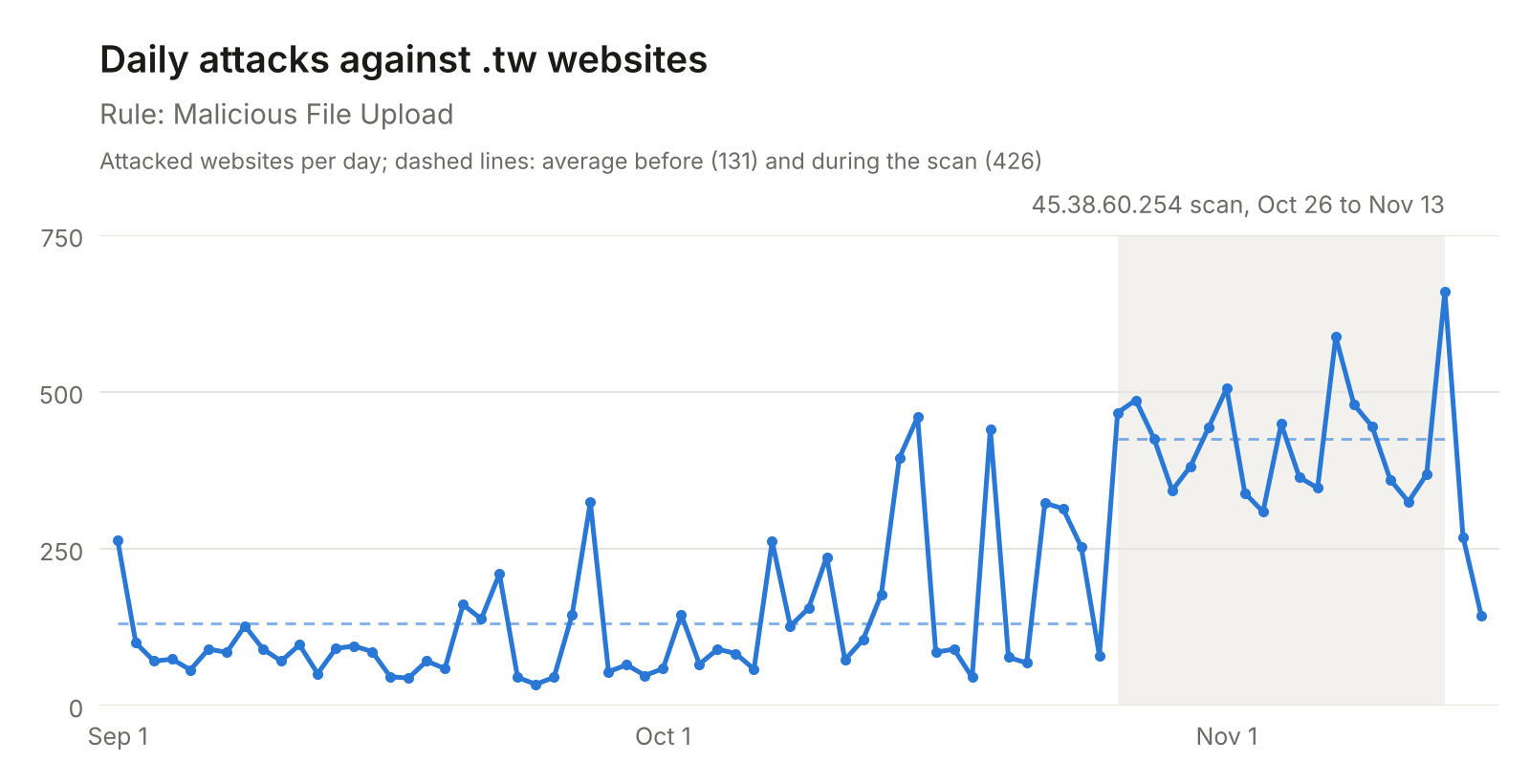
From October 26th to November 13th, 2026, an average of 426 .tw websites a day had requests blocked by the Malicious File Upload rule. Over the previous eight weeks the average was 131.
SQL Injection
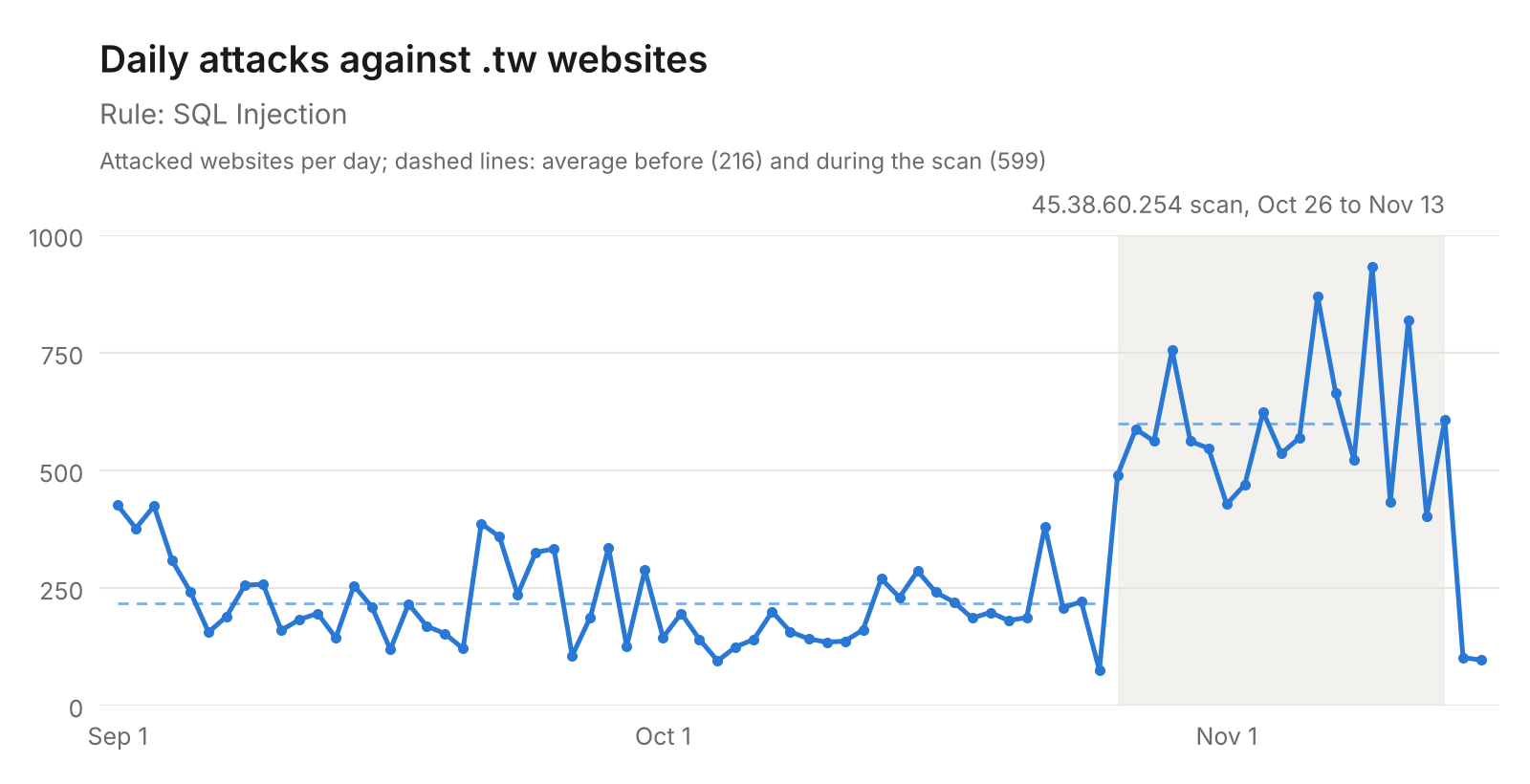
The SQL Injection rule shows the same trend. The average number of .tw websites with blocked SQL Injection requests increased from 216 a day to 599 a day in the same period. On November 14th and 15th, the number fell back to 102 and 97.
Comparison with the other domains
The chart below compares the two periods for every domain and firewall rule. Each value is the daily average of attacked websites from October 26th to November 13th divided by the daily average from September 1st to October 25th.
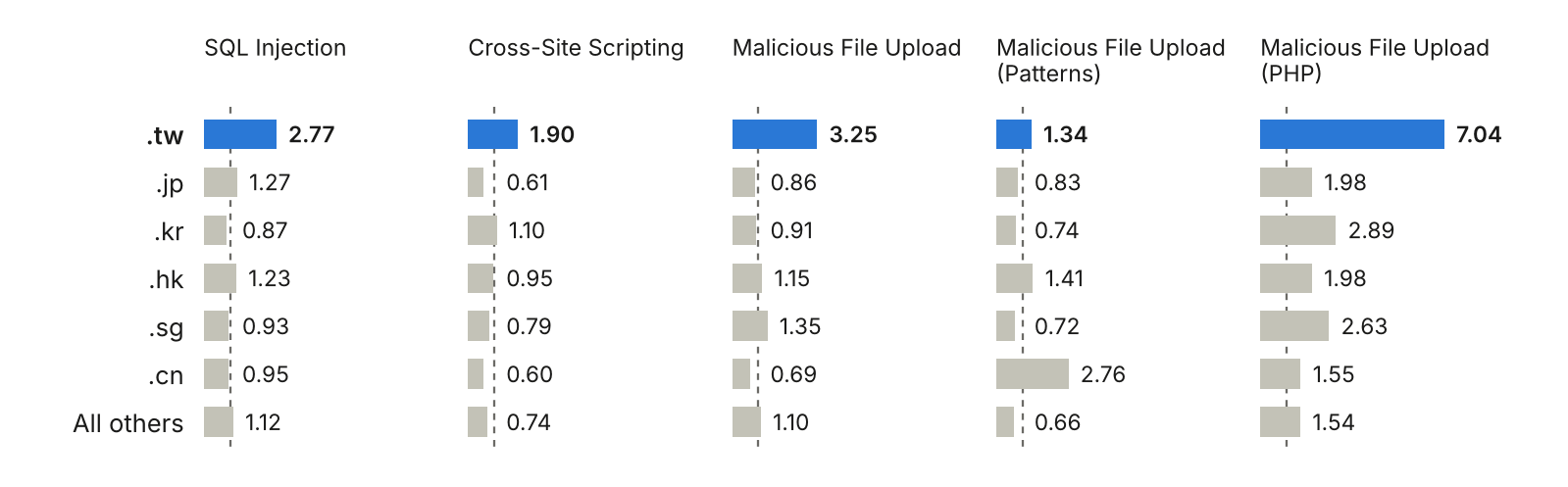
The number of attacked .tw websites increased 3.25 times for Malicious File Upload and 2.77 times for SQL Injection. For the other domains, these two values stay between 0.69 and 1.35. Malicious File Upload (PHP) increased on several domains, but the sevenfold increase on .tw is by far the largest.
One address explains the increase
To find out what changed on October 26th, we ranked the IP addresses behind the November Malicious File Upload (PHP) blocks on .tw websites. One address led the list: 45.38.60.254.
This address triggered the rule 831 times on 403 .tw websites and 238 times on 122 websites under other top-level domains. It did not trigger it once on a .jp, .kr, .hk, .sg or .cn website. The next two addresses in the ranking hit .tw 328 and 113 times, but they also sent 7,595 and 2,322 such requests to the rest of the world. These two addresses attack websites worldwide, while 45.38.60.254 almost exclusively targets .tw websites.
On the three days when this rule peaked on .tw, that one address reached most of the websites affected.
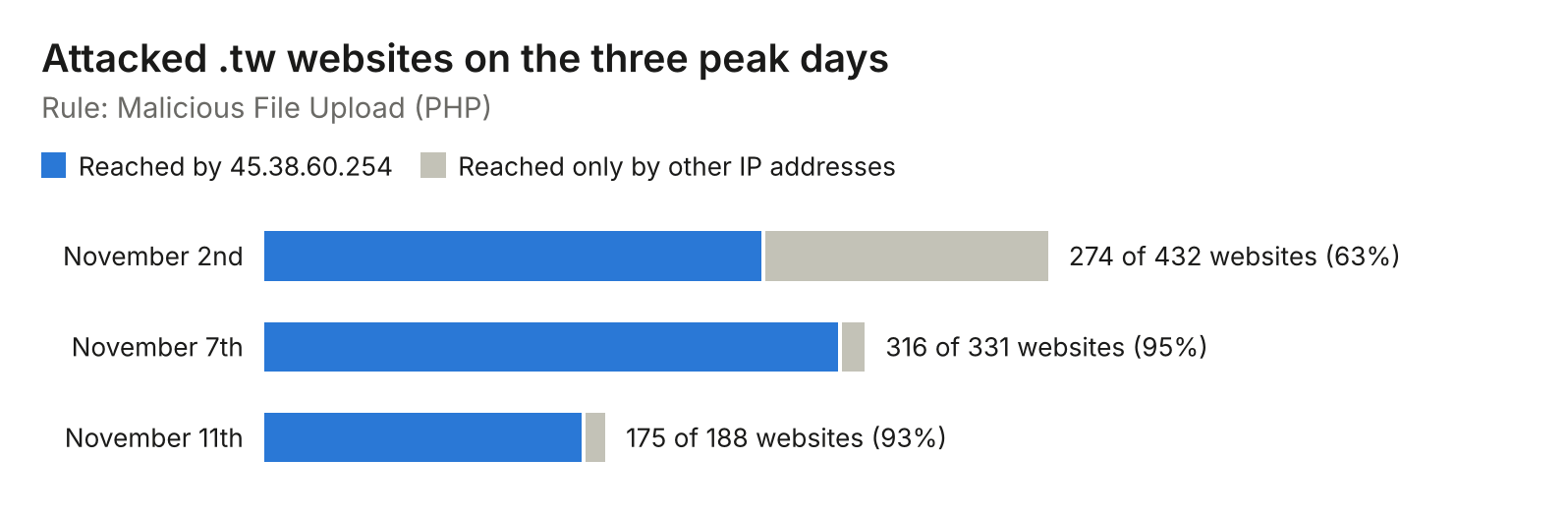
The general Malicious File Upload rule shows the same pattern. Adding up the daily counts of attacked .tw websites from November 1st to 13th gives 5,541, and 45.38.60.254 accounts for 3,732 of them, or 67%.
A closer look at the attack data
The address first appeared in our data on October 26th, 2026. Between October 26th and November 13th, it reached between 568 and 863 websites protected by Wordfence every day. From November 14th, this number dropped to 15 websites or fewer.
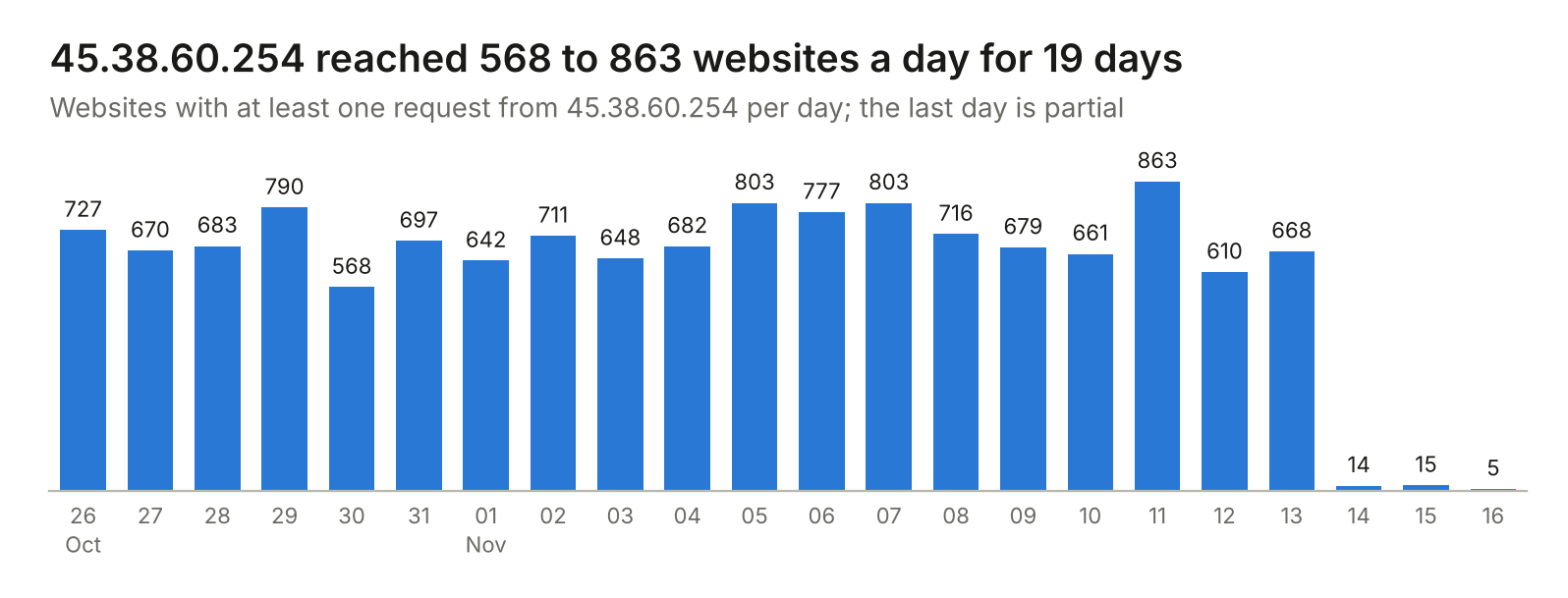
In November, the Wordfence Firewall blocked requests from this address under the following generic rules.
| Firewall rule | Blocked requests | Websites |
|---|---|---|
| SQL Injection | 29,399 | 1,093 |
| Directory Traversal | 21,870 | 1,022 |
| Malicious File Upload | 13,563 | 771 |
| Local File Inclusion | 5,812 | 680 |
| Cross-Site Scripting | 4,691 | 664 |
| Directory Traversal via HTTP Headers | 2,957 | 579 |
| Malicious File Upload (PHP) | 2,957 | 525 |
We examined the requests blocked by the two Malicious File Upload rules in detail. According to our logs, all of them were attempts to exploit known, previously disclosed vulnerabilities in WordPress plugins and in other web software. The CVE identifiers found in the payloads range from 2017 to 2024. The uploaded files did not contain a web shell or a backdoor, only a short PHP snippet that prints a hash, which is used to check whether the upload succeeded.
Example attack request
POST /jquery-file-upload/server/php/index.php HTTP/1.1
Host: [redacted]
User-Agent: Mozilla/5.0 (X11; Ubuntu; Linux i686; rv:24.0) Gecko/20100101 Firefox/24.0
Content-Type: multipart/form-data; boundary=----WebKitFormBoundary3Lom31oWS2nITsIk4U2Itg2bfQg

------WebKitFormBoundary3Lom31oWS2nITsIk4U2Itg2bfQg
Content-Disposition: form-data; name="files[0]"; filename="dQFMK0WG.php"
Content-Type: application/x-php

<?php echo md5("CVE-2018-9206"); ?>
------WebKitFormBoundary3Lom31oWS2nITsIk4U2Itg2bfQg--
Of the 771 websites where the Malicious File Upload rule blocked requests from this address, 610 (79%) are on the .tw top-level domain and 129 (17%) are on .com top-level domain. Based on their domain names, the targeted .com websites also appear to have ties to Asia.
This suggests that the attacker was most likely mapping Taiwanese websites, including WordPress sites, for known vulnerabilities. All of the requests described above were blocked by the generic rules of the Wordfence Firewall, and no vulnerability-specific firewall rule was required.
Conclusion
In today’s article, we followed a statistical anomaly back to its source. A rise in attacked .tw (Taiwan) websites that had no counterpart on .jp (Japan), .kr (South Korea), .hk (Hong Kong), .sg (Singapore) and .cn (China) turned out to be the work of one IP address, 45.38.60.254. Our records indicate that the scan started on October 26th, 2026. The Wordfence Firewall blocked or logged over 246,000 requests from this address. According to our logs, these were attempts to exploit known vulnerabilities, which our generic firewall rules blocked, and none of the uploads we inspected carried a web shell or a backdoor.
The case is a useful reminder of how little it takes to change the picture for a whole region. The increase we measured on .tw was largely one scanner’s coverage of one list, not a broad rise in hostile interest. It is also a reminder that a quiet probe today can become a targeted attack tomorrow, which is why we will keep watching for the same scan from other addresses.
If you have friends or colleagues running websites in Asia, be sure to forward this article to them, as their sites were likely probed as well.
If you believe your site has been compromised, Wordfence Care includes incident response, and Wordfence Response offers the same service around the clock with a one-hour response time.
The post 45.38.60.254: the Scanner Behind the November 2026 Rise in Attacks on .tw Websites appeared first on Wordfence.